Robotics
The hidden winners of Physical AI: Why robot data factories could become a billion-dollar industry
The bottleneck in next-generation robotics is shifting from hardware to manipulation data, VLA models, real-world evaluation and a closed learning loop. This analysis explains the business model and the Korea–Vietnam opportunity.
542,000
industrial robots installed in 2024
74%
of new installations were in Asia
1M+
demonstrations in Open X-Embodiment
Key conclusions
- 1The robotics bottleneck is shifting from hardware to data, learning and evaluation infrastructure
- 2Asia accounted for 74% of new industrial robot deployments in 2024
- 3Platforms combining real, synthetic, simulated and deployment data are becoming more valuable
Impact on Korean companies — Companies connecting Korean manufacturing demand with Vietnamese AI and data operations can evolve from collection services into repeatable robot-learning and deployment software.
Contents
- 01Start with a simple packing example
- 02What does the company actually sell?
- 03Where do humanoid robots fit?
- 04Why is robot data difficult and expensive?
- 05The six steps inside a robot data factory
- 06Why is this opportunity opening now?
- 07How can the company make money?
- 08Why Korea and Vietnam fit together
- 09How to judge whether the company is real
- 10The biggest risks
- 11The simple conclusion
Humanoid robots are appearing in more factories and videos. Yet the hardest problem is not building a body that can walk or hold an object. The harder problem is teaching it to work reliably when objects, lighting and positions keep changing.
The company type discussed here can be explained in one sentence: it turns human work into skills that robots can learn, repeat and improve.
> If hardware is the robot's body, data and learning software are its vocational school.
Start with a simple packing example
Imagine a factory wants a robot to place products into boxes. If every box is always in the same position, an engineer can program a fixed path: pick at point A, move to point B and release. Traditional industrial robots are excellent at this.
Reality is less tidy. A box moves a few centimeters. A bag wrinkles. A product arrives at a different angle. The robot misses a grasp or drops an item. A fixed program can stop when any of these things happen.
A newer robot must use cameras to understand the scene, choose where to grasp and adjust after a mistake. Like a new worker, it needs to watch and practise many successful and failed examples.
That is where robot-data infrastructure companies enter.
What does the company actually sell?
It does not necessarily manufacture the robot. It can sell a “robot teaching system” with five simple parts:
- Record a human demonstrating the task through the robot.
- Clean the recordings and mark success and failure.
- Train the robot to act without direct control.
- Test speed, accuracy and safety in the real factory.
- Collect new failures after deployment and improve the skill.
Customers do not pay because data sounds exciting. They pay to solve a clear problem: labor shortages, dangerous work, unstable quality or the need to run a line for more hours.
Where do humanoid robots fit?
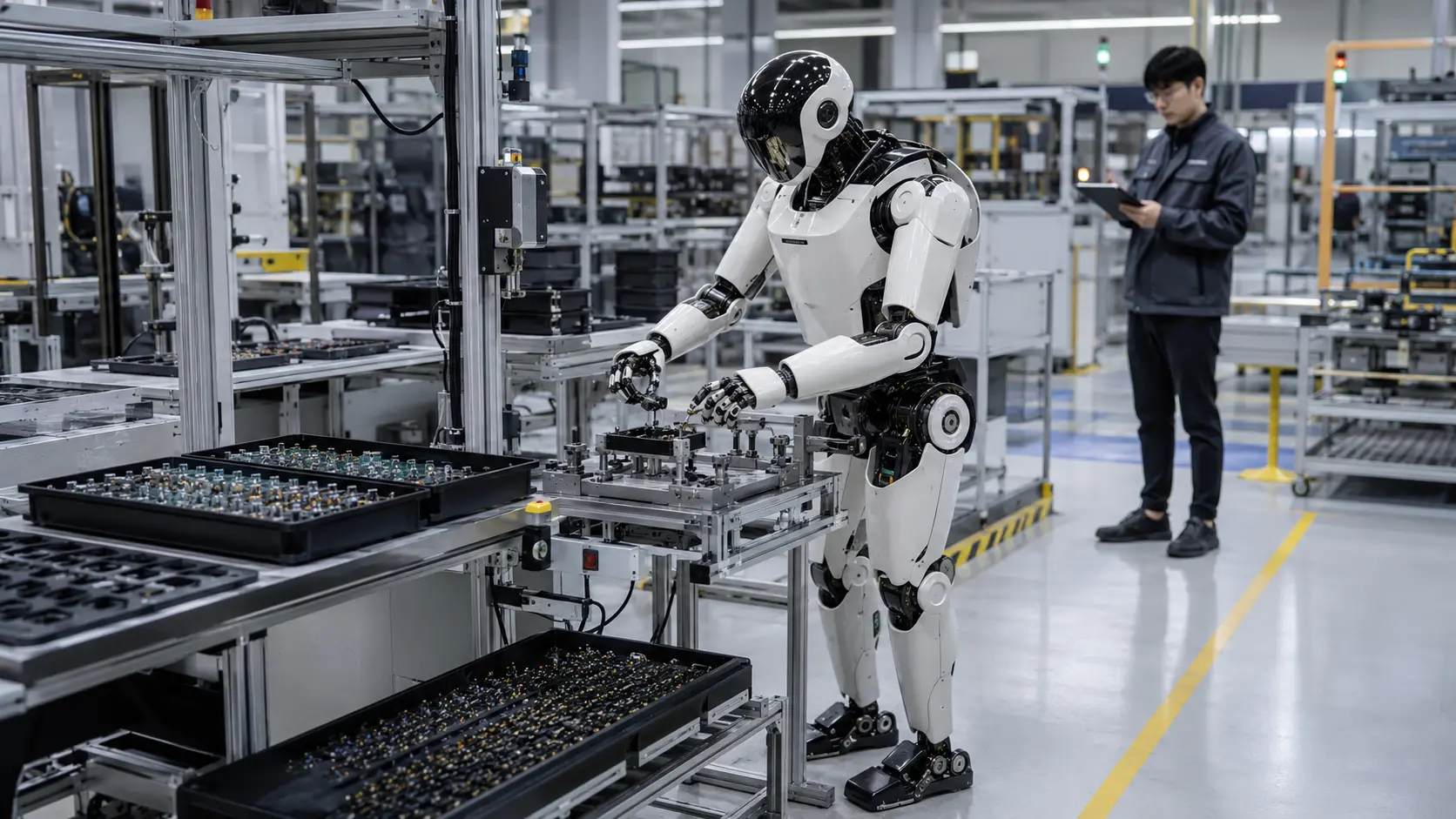
A humanoid has a torso, two arms and usually two legs. Its practical advantage is compatibility. Factory doors, shelves, carts, tools and worktables were designed around the human body.
A humanoid may therefore use existing spaces and tools without forcing the factory to rebuild everything.
The first commercial cases remain narrow:
- Figure 02 loaded sheet-metal parts into fixtures on a BMW production line. The company reported more than 90,000 parts handled across over 1,250 operating hours.
- Agility Robotics' Digit has been used by GXO to move totes from mobile robots onto conveyors.
- Other candidates include shelf picking, parts kitting, machine tending, inspection and work in hot or toxic areas.
This does not mean humanoids can replace people everywhere. If a fixed robot arm is faster and cheaper, the factory should use that arm. A humanoid makes the most sense when a job combines movement, perception and two-handed work in a space made for people.
Why is robot data difficult and expensive?
Text can be collected from the Internet. Robot data must be created in the physical world.
A training session needs a robot, cameras, sensors, a safe work area and an operator. The team must then synchronize video with movement, check contact forces, identify why an item was dropped and label the outcome.
Failure data is especially valuable. A commercial robot must know not only how to succeed, but also how to recover from a missed grasp, an unknown object or a blocked path.
Google DeepMind worked with 33 laboratories to build Open X-Embodiment, covering 22 robot types and more than one million demonstrations. That scale shows why one company may struggle to create enough diverse data alone.
The six steps inside a robot data factory
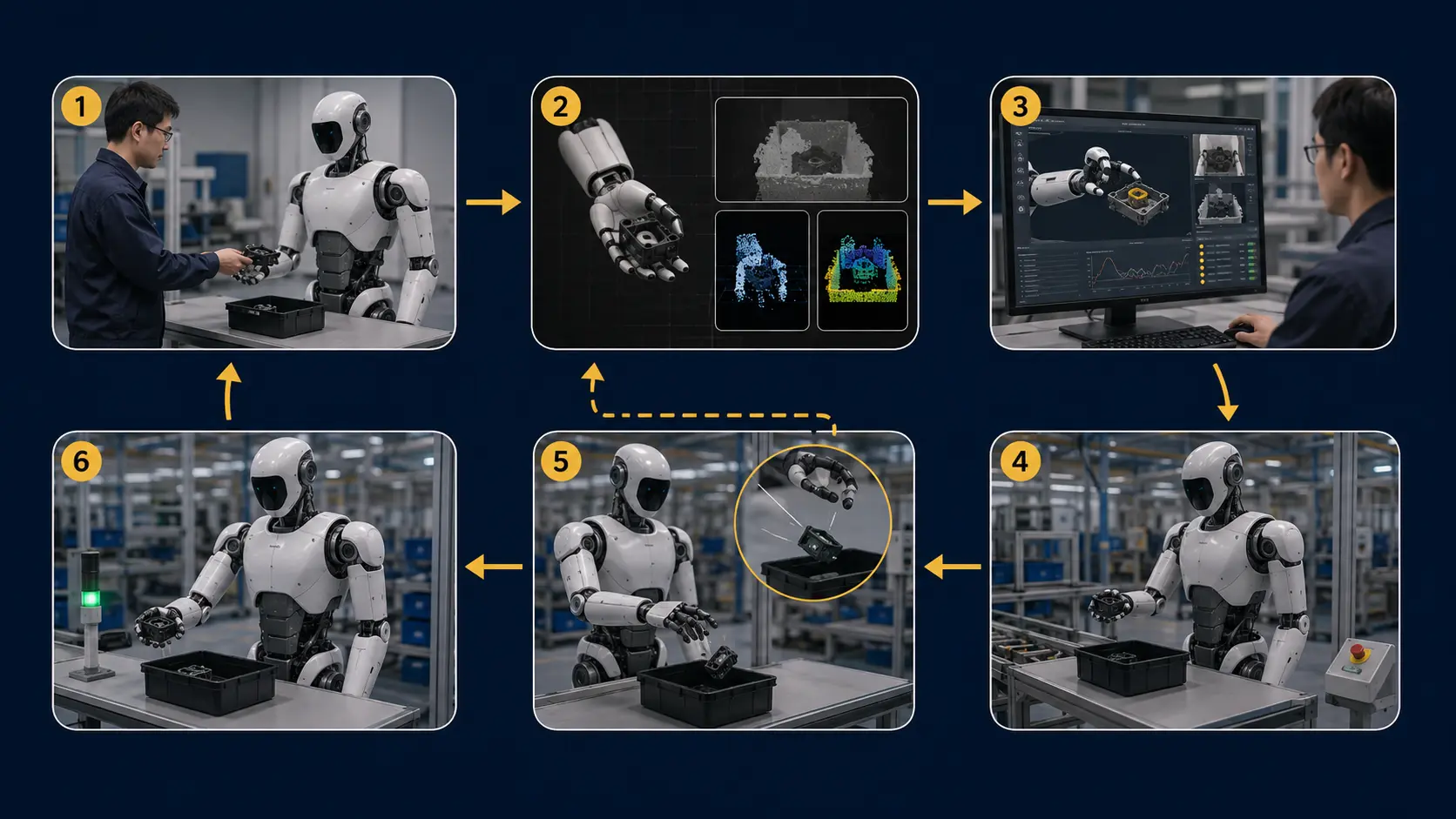
1. A person demonstrates the work
An operator controls the robot to pick, place, open or assemble an object. Cameras and sensors record the process.
2. The team selects good recordings
Unsafe or incorrect attempts are removed. Each trial receives a clear start, finish and outcome.
3. The motion is adapted to another robot body
Robots differ in arm length, joints and grippers. The software adapts the purpose of an action to a new body, much like adjusting the same dance for people of different heights.
4. The robot learns
Vision–Language–Action, or VLA, sounds technical but means something simple: the robot sees, understands an instruction and creates an action.
5. The skill is tested in the factory
A good video is not enough. The robot must meet the required cycle time and work reliably across thousands of repetitions without constant human help.
6. Failures become new lessons
New situations from the factory return to training. More deployed robots create more real examples, which can improve the product. This is the data flywheel.
Why is this opportunity opening now?
The International Federation of Robotics reports that about 542,000 industrial robots were installed worldwide in 2024. Asia represented 74% of new installations.
When a company owns a few robots, engineers can program each one separately. At hundreds of thousands of robots and many changing tasks, manual programming becomes too slow. The market needs shared tools for teaching, testing and updating robot skills.
Computer vision has improved, onboard computing is stronger and simulation is cheaper. Together, these changes make learning robots more practical than before.
How can the company make money?
There are four main revenue streams:
1. Project fees for automating a customer's specific task.
2. Recurring software fees for managing data, models, testing and deployment.
3. Operating fees based on robot count or runtime.
4. Outcome fees based on successful units or labor hours saved.
Early revenue may depend heavily on services. The important question is whether each project becomes reusable software.
If every new customer requires the company to hire the same number of teleoperators, it still behaves like a labor service. If one system can support more and more robots, margins and company value can grow much faster.
Why Korea and Vietnam fit together
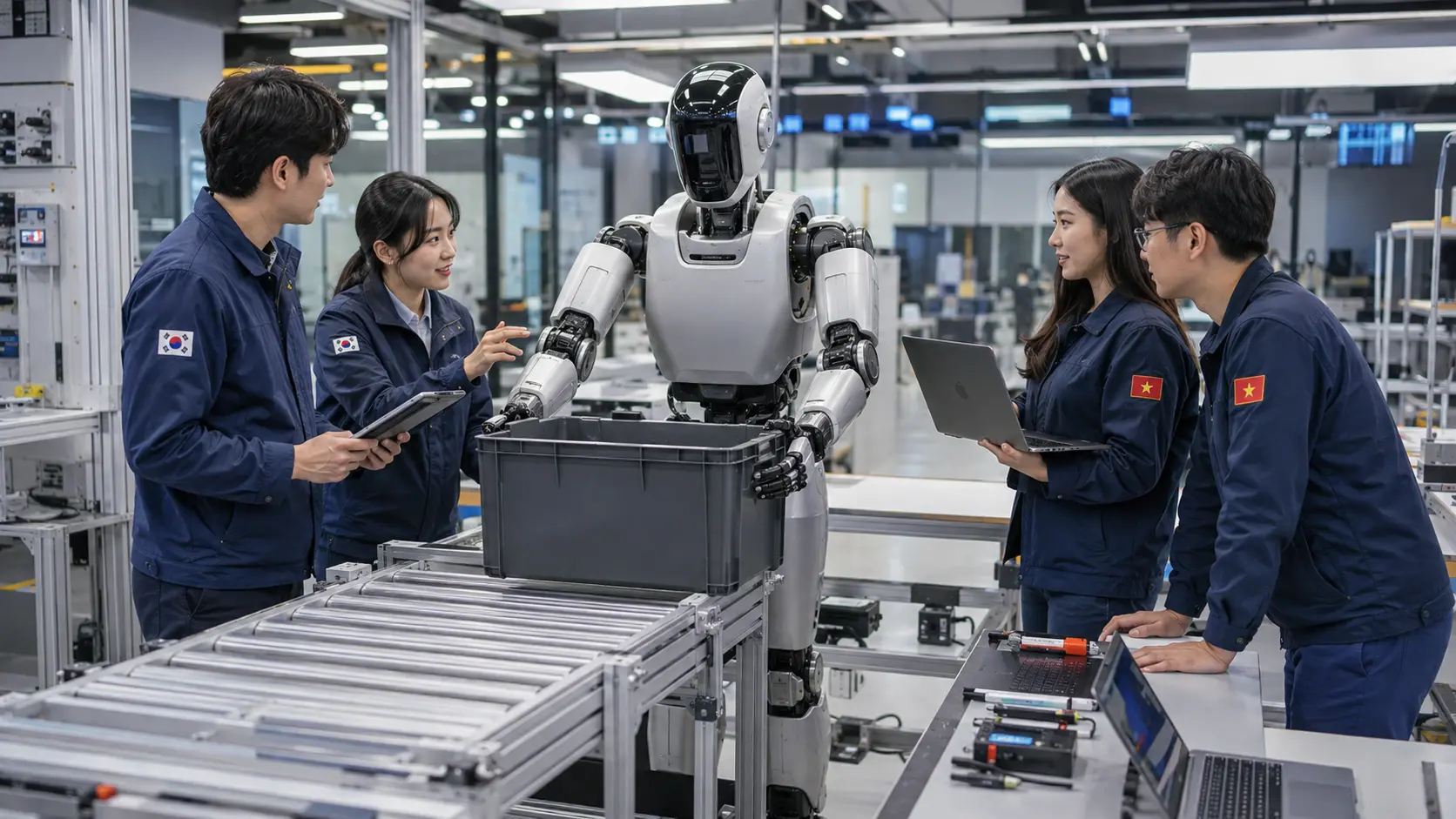
Korea has the world's highest industrial robot density. Electronics, automotive, batteries and semiconductors provide large factories with real automation problems and budgets.
Vietnam can scale software, AI, simulation and data-quality teams. Its electronics, textile, food, furniture and components factories also provide varied production environments.
The stronger model is not “Korea sells and Vietnam supplies cheap labor.” Korea can lead core research, customer discovery and factory integration. Vietnam can lead software, simulation, data operations and evaluation. Both teams then improve one shared product using factory data.
How to judge whether the company is real
Do not judge only by a robot video. Ask:
1. What is the success rate in a real factory?
2. How long does each unit take?
3. How often must a person intervene?
4. Which failures can the robot recover from?
5. How many data hours are needed for a new skill?
6. How long does transfer to another robot take?
7. Does the customer keep paying after the pilot?
8. What share of revenue is recurring software?
9. Is cost per successful operating hour falling?
10. How is factory data protected?
A video shows possibility. A paying contract and thousands of operating hours show a product.
The biggest risks
The largest risk is the gap between a demo and production. A robot can work for five minutes on camera and still stop repeatedly across a full shift.
Other risks include expensive hardware, different robot designs, long factory sales cycles and safety liability. Factory data may reveal processes and product designs, so on-premise security, access control and audit logs must be part of the product.
The simple conclusion
Physical AI is AI that can perceive and act in the real world. Humanoids are one highly visible form, not the entire market.
The larger business opportunity is not only selling a robot. It is building the system that helps many robots learn faster, work more reliably and keep improving after deployment.
In plain language, this company is not just selling a machine shaped like a person. It is building the vocational school and learning operating system for robots.
Opportunities
- Bimanual manipulation data collection, curation and evaluation
- Vietnam-based data and simulation centers for Korean robotics firms
- Task-specific automation in electronics, components and food production
Risks
- A large gap between demos and long-duration production reliability
- Low margins and price competition if the business remains labor-led
- Factory-data rights, security and safety liability
Recommended actions
- Design a paid pilot around a narrow task with measurable ROI
- Use success rate, cycle time, intervention and recovery as shared KPIs
- Verify ownership of cross-embodiment, evaluation and edge-deployment software
KVBiz · Vietnam Entry
Free assessment of your Vietnam entry & site selection
Share your sector, goals and expected scale, and we will outline the right region and industrial parks, labor/cost conditions and entry mode (entity, leased factory or partner). A precise quote follows once requirements are confirmed.
Your information is used only for assessment and consultation.
Sources & methodology
- 01International Federation of Robotics — World Robotics 2025 — Industrial Robots ↗
- 02International Federation of Robotics — Robot Density Surges in Europe, Asia, and Americas ↗
- 03Google DeepMind — Scaling up learning across many different robot types (primary source) ↗
- 04Google DeepMind — Gemini Robotics On-Device brings AI to local robotic devices (primary source) ↗
- 05NVIDIA — Isaac GR00T N1 and simulation frameworks for robot development (primary source) ↗
This independent KVBiz analysis is based on public materials from IFR, Google DeepMind and NVIDIA. It does not recommend any specific company or investment.
Related insights

Electronics
Vietnam Hai Phong entry guide 2026 — LG cluster, deep-water port, labor cost
Hai Phong, LG's largest Vietnam base and home to the north's only deep-water port (Lach Huyen) — industrial parks, minimum wage (Region I), manufacturing labor cost, logistics, and downstream opportunities and risks, for Korean companies.

Electronics
Vietnam Bac Ninh entry guide 2026 — Samsung cluster, industrial parks, labor cost
Bac Ninh, Vietnam's largest Korean cluster (Samsung SEV and Samsung Display) — industrial parks, minimum wage (Region II), manufacturing labor cost, logistics, and downstream opportunities and competition, for Korean companies.
cross-border-investment
Vietnam Circular 38 takes effect: what Korean companies should check before M&A, capital increases and profit remittance
Circular 38/2026/TT-NHNN took effect on 18 August 2026, reshaping foreign-investment FX administration in Vietnam. Korean investors should re-check ownership thresholds, investment capital accounts, M&A payment routes, deal currency and remittance documents.