precision machining
Why Korean manufacturers are evaluating precision machining outsourcing in Vietnam: 2026 data and a practical CNC sourcing workflow
South Korea accounted for US$5.7 billion of Vietnam's newly licensed FDI in January–September 2026, while Vietnam's processing and manufacturing output index grew 12.9%. These are macro indicators—not CNC outsourcing orders. A practical guide to CNC, sheet-metal and fixture sourcing, illustrative total-cost calculations, supplier qualification and a six-stage RFQ process.
US$5.7bn
Korean newly licensed FDI in Vietnam, Jan–Sep 2026
+12.9%
Vietnam manufacturing/processing IIP, Jan–Sep 2026
US$89.5bn
2025 Vietnam–Korea trade, Vietnamese data
Key conclusions
- 1Korean newly licensed Vietnam FDI US$5.70bn (19.5% share) in Jan-Sep 2026; not CNC sourcing turnover.
- 2Vietnam manufacturing/processing IIP grew 12.9% y/y in Jan-Sep 2026.
- 3Six practical supplier qualification stages from RFQ/NDA to sample FAI and delivery.
Impact on Korean companies — A procurement decision framework for Korean manufacturers sourcing CNC parts, sheet-metal assemblies and industrial fixtures in Vietnam.
Contents
- 01What the 2026 data actually shows
- 02A more direct machining-industry signal: machine tools and cutting inserts
- 03Three practical reasons for Korean buyers to evaluate Vietnam
- 04Illustrative 200-piece procurement: landed cost versus lead time
- 05Six practical steps from CNC RFQ to delivery
- 06Eight questions buyers should ask every prospective supplier
- 07Frequently asked questions
- 08Start with one real specification
Imagine a Korean automation company that needs 200 precision-milled aluminum brackets. A domestic machine shop can often shorten design iterations and first-article checks. A Vietnamese manufacturer may be worth evaluating for repeat orders and supply-chain diversification, but shipping, inspection, import obligations and rework must all be priced. The purchasing decision is not simply “which unit quotation is lower?” but which supplier can deliver the same specification at an acceptable total cost, quality level and date?
This practical brief uses publicly available data as of 3 November 2026. Importantly, the official numbers below do not measure CNC outsourcing orders, machining market size or supplier capacity. They describe the broader investment and industrial setting in which Korean buyers can evaluate Vietnam sourcing.
What the 2026 data actually shows
According to Vietnam's national statistics, newly licensed foreign direct investment totalled US$29.24 billion during January–September 2026. South Korea ranked second after Singapore with US$5.70 billion, or 19.5% of newly registered project capital. That is evidence of a substantial Korean investment presence—not proof of increased CNC purchase orders.
Vietnam National Statistics Office and government news portal. Newly licensed investment only, not machining procurement.
Vietnam's index of industrial production (IIP) for processing and manufacturing increased 12.9% year on year in the first nine months of 2026, compared with 10.3% in the same period of 2025. The nationwide industrial IIP, across all industries, rose 12.4% over January–October 2026. These are different scopes and time windows.
Vietnam National Statistics Office, same-period year-on-year comparisons
Vietnam's Ministry of Industry and Trade cited US$89.5 billion in Vietnam–Korea merchandise trade for 2025 under Vietnamese statistics. Korean statistics put the same broad trade relationship at approximately US$94.6 billion; methodologies differ. Neither figure isolates outsourced precision machining services.
A more direct machining-industry signal: machine tools and cutting inserts
A November 2025 Vietnam cutting-tools market report from KOTRA's Hanoi office cited Euromonitor estimates showing Vietnamese machine-tool sales growing from approximately US$60 million in 2019 to US$100 million in 2024—roughly 67% over five years. This is a historical market estimate for machinery, not a 2026 measurement of precision outsourcing orders or approved supplier capacity.
KOTRA Hanoi office, November 2025, citing Euromonitor. Machinery sales, not machining service contracts.
The same KOTRA report said imports of replaceable metal-cutting tools and inserts (HS 8209) reached about US$43.87 million in 2024, up 16.4% year on year. Tooling demand is relevant evidence of a growing machining ecosystem; a buyer still must verify each factory's machines, metrology, tolerances, quality history and ability to export to Korea.
Three practical reasons for Korean buyers to evaluate Vietnam
1. A second source for stable recurring parts
A qualified supplier can reduce dependence on a single factory. Stable drawings, repeat batch volumes and clear acceptance criteria are particularly helpful. A company directory entry is not evidence that a shop can meet a specific tolerance or delivery date.
2. Jigs, brackets and enclosures for automation
Precision-milled brackets, sheet-metal control cabinets and custom assembly fixtures are recurring categories in equipment projects. Suitable capabilities differ by item: CNC milling and turning, bending, welding, finishing, calibration and outsourced-process controls all matter.
3. Better visibility into the landed-cost breakdown
Comparable quotations require identical material grades, drawing revisions, annual volumes, inspection rules, packing, delivery locations and Incoterms. Otherwise a cheaper-looking quote may transfer risks or charges to the importer.
| Typical purchase | Production process | Procurement checkpoint |
|---|---|---|
| Aluminum bracket | CNC milling, drilling, finishing | Revision, datum, threads, tolerance and surface finish |
| Sheet-metal cabinet | Laser cutting, bending, welding, coating | Thickness, bend radius, distortion and coating |
| Assembly jig/fixture | Precision machining, assembly, measurement | Repeatability, inspection reference and calibration |
| Prototype batch | DFM, machining and testing | Engineering changes, sample approval and lead time |
Illustrative 200-piece procurement: landed cost versus lead time
This table uses fictional, editable assumptions solely to demonstrate the mathematics of sourcing. It is not a current Korean or Vietnamese market quote, surveyed price, supplier offer, exchange-rate forecast or savings guarantee. All values are denominated in Korean won (KRW).
| Cost component | Made in Korea | Made in Vietnam |
|---|---|---|
| Unit price × 200 pieces | ₩9,600,000 | ₩6,600,000 |
| Setup and tooling | ₩200,000 | ₩450,000 |
| Freight and packaging | ₩150,000 | ₩600,000 |
| Quality inspection | ₩100,000 | ₩250,000 |
| Assumed customs and extra fees | ₩0 | ₩180,000 |
| Modeled total landed cost | ₩10,050,000 | ₩8,080,000 |
| Illustrative sequential lead time | 23 days | 39 days |
Under these hypothetical inputs, Vietnamese sourcing appears ₩1.97 million (approximately 19.6%) cheaper but 16 days slower. The real answer may reverse once urgent freight, defects, exchange-rate movements, import VAT, duties, inventory or rework costs are included.
Change the assumptions in the interactive Korea–Vietnam sourcing calculator.
Six practical steps from CNC RFQ to delivery
- 01
Define RFQ
Drawing revision, volume, material and lead time
- 02
NDA and DFM
Agree secure CAD sharing and manufacturability
- 03
Qualify factory
Equipment, metrology and subcontractors
- 04
Sample and FAI
Validate first article against drawings
- 05
Production QC
Monitor batches, traceability and defects
- 06
Export and reorder
Incoterms, import files and delivery KPIs
An illustrative qualification sequence—not a guaranteed service level or certification. Steps vary by part, industry and contract.
| Stage | Documentation to request | Decision gate |
|---|---|---|
| 1. RFQ | STEP/DWG/PDF requirements, quantity, finish, inspection plan | Is the quote truly like-for-like? |
| 2. NDA / DFM | Document permissions, deviation and change procedures | Who owns drawing changes and confidential data? |
| 3. Factory screening | Machines, metrology/calibration and quality records | Can this shop actually make this part? |
| 4. Prototype / FAI | First Article Inspection, measurements, material certificates | Is the sample conforming? |
| 5. Production QC | Lot traceability, inspection data, nonconformance actions | Is repeat quality controlled? |
| 6. Delivery | Packing, shipping paperwork, origin documents, named Incoterm | Are responsibilities and landed cost clear? |
A 5-axis milling machine or an ISO badge alone does not demonstrate suitability for the buyer's drawing. Verify measurement capabilities, independent processing steps and trial production results. KVBiz does not certify any factory merely because its website appears in research.
Eight questions buyers should ask every prospective supplier
- Has the factory made this type of part with the proposed material and process?
- How will drawing tolerances and critical dimensions be measured and recorded?
- Can material, heat treatment and surface finishing certificates be traced to each batch?
- Who controls external operations such as coating, welding and plating?
- What happens to price and schedule when a drawing revision is released?
- How are nonconforming parts, rework, returns and production delays handled?
- Which precise Incoterms® 2020 rule and named delivery place apply?
- Who will handle Korean customs, import requirements and follow-up deliveries?
Incoterms® 2020 can clarify delivery tasks, costs and risk transfer. It does not determine product quality, HS classification, preferential origin or duties by itself. Buyers should confirm these issues separately before purchase.
Frequently asked questions
Is Vietnam CNC machining always cheaper than Korea?
No. Unit prices alone omit tooling, QC, shipping, import costs, schedule risk and rework. The model above is entirely hypothetical.
How can a Korean buyer evaluate machining precision?
Ask for drawing-specific metrology, calibrated equipment, first-article inspection results and traceable material/finishing documentation.
Should urgent prototypes be outsourced to Vietnam?
That depends on the part, manufacturing route and delivery date. Frequent redesigns and urgent tests may favor domestic suppliers.
Can confidential CAD files be uploaded to a public form?
Do not upload proprietary drawings through an unsecured public inquiry. Start with a non-sensitive scope, then agree an NDA and file-transfer controls.
What is the minimum order quantity for Vietnamese machine shops?
There is no universal MOQ. It varies by material, fixture requirements, process and shop loading. Obtain comparable RFQs for the actual quantity tiers.
Start with one real specification
Vietnam machining outsourcing is a structured procurement decision, not a claim that every factory offers low prices. Korean buyers can begin with a non-confidential part description, material, target quantity, delivery location and inspection requirements.
KVBiz supports supplier discovery, comparative RFQ reviews, sample planning and Korea–Vietnam coordination, without guaranteeing a manufacturing contract or delivery result.
Explore CNC, sheet-metal and fixture sourcing
**Request a manufacturing RFQ discussion →**
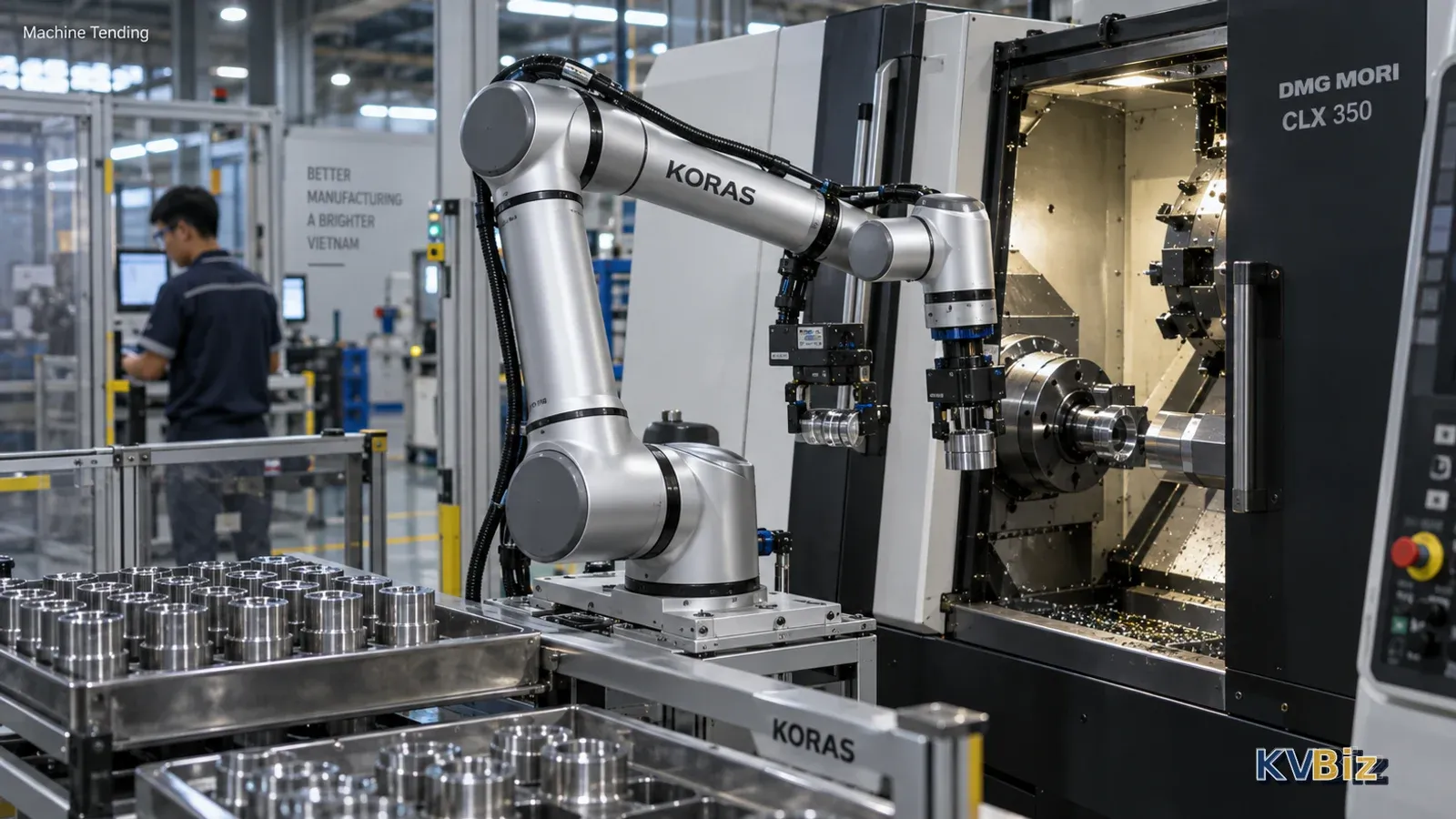
Data checked 3 November 2026. Macro FDI, trade and production figures are not direct measurements of the CNC outsourcing market. Cost and time inputs are fictional teaching examples. The cover is an AI-generated editorial image, not a photograph of a verified Vietnamese factory or customer delivery.
Opportunities
- Stable recurring parts with dual-sourcing potential
- Factory qualification and traceability
Risks
- Quality/rework and inspection risk
- Freight, customs, currency and lead-time exposure
Recommended actions
- Use identical drawings/specs in 2-3 RFQs
- Approve an FAI prototype before mass production
- Validate Incoterms and Korean customs requirements
KVBiz · Vietnam Entry
Free assessment of your Vietnam entry & site selection
Share your sector, goals and expected scale, and we will outline the right region and industrial parks, labor/cost conditions and entry mode (entity, leased factory or partner). A precise quote follows once requirements are confirmed.
Your information is used only for assessment and consultation.
Sources & methodology
- 01베트남 정부 포털 (Chinhphu.vn) — 2026년 1~9월 외국인투자 발표: 한국 신규 승인 57억 달러 (primary source) ↗
- 02베트남 국가통계국 (NSO) — 2026년 3분기 및 1~9월 베트남 사회경제 통계 (primary source) ↗
- 03베트남 산업무역부 (MOIT) — 2025 Vietnam–Korea trade and 2026 bilateral industrial cooperation (primary source) ↗
- 04베트남 국가통계국 (NSO) — 2026년 10월·1~10월 산업생산지수 (primary source) ↗
- 05국제상공회의소 (ICC) — Incoterms® 2020: international delivery terms and responsibilities (primary source) ↗
- 06KOTRA 하노이무역관 — 베트남 절삭공구 시장동향 (Vietnam Cutting Tools Market Trends, 2025.11) ↗
The cited FDI, trade and manufacturing statistics are macro indicators, not measurements of CNC outsourcing demand. The cost and lead-time examples are fictional, not binding quotations. The editorial cover is AI-generated and does not depict a verified factory or customer delivery.
Related insights

cross-border-investment
Vietnam Circular 38 takes effect: what Korean companies should check before M&A, capital increases and profit remittance
Circular 38/2026/TT-NHNN took effect on 18 August 2026, reshaping foreign-investment FX administration in Vietnam. Korean investors should re-check ownership thresholds, investment capital accounts, M&A payment routes, deal currency and remittance documents.

OEM
Vietnam canvas tote and pouch OEM for Korean brands: 2026 sourcing guide, MOQ, costs and quality process
How should Korean cosmetics brands, event organizers and retail businesses source canvas tote bags, zipper pouches and reusable gift sets from Vietnam? An evidence-based guide to industry data, scope of customs statistics, hypothetical landed costs, sample approval, QC and a six-step OEM procurement process.

IT_AI
The AI operating factory: A practical market-entry strategy for Vietnam
A plain-language guide to the business of managing GPUs, data, models and AI Agents — and a five-step route for foreign technology companies seeking their first paying customer in Vietnam.