386 Korean projects in Phu Tho: a new Korea–Vietnam industrial cluster
By end-2025 Phu Tho hosted 386 Korean FDI projects worth about USD 5.27 billion, roughly 40% of the province total. The real opening is not another greenfield site but the supply chain forming around the hundreds of plants already running there.
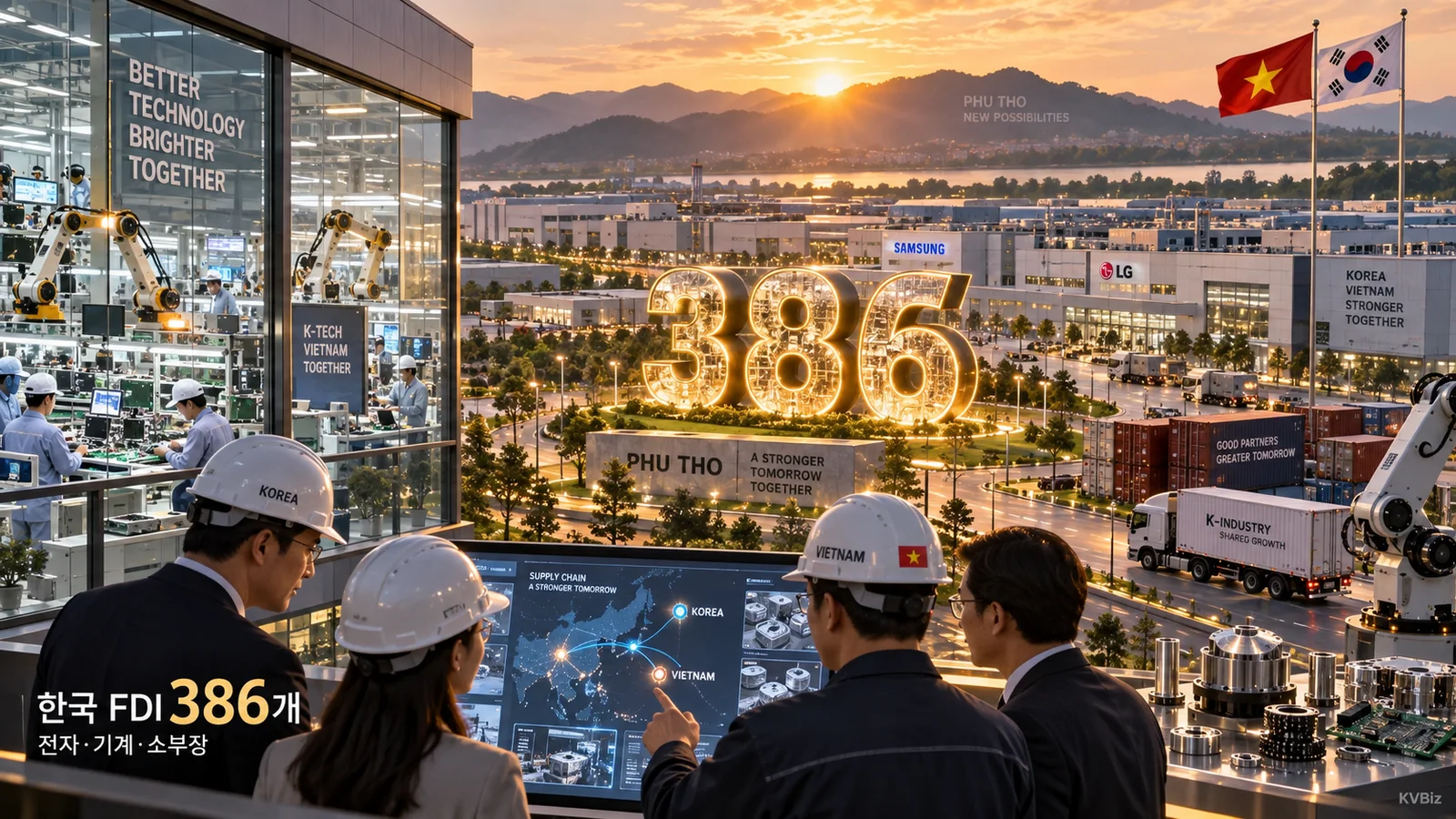
By the end of 2025, Phu Tho province hosted 386 Korean FDI projects with about USD 5.27 billion in registered capital. The number of projects is not the interesting part. Behind it sits a fast-growing production ecosystem in electronics, precision engineering and supporting industries — one where both Korean and Vietnamese companies can find new business.
According to the Vietnam Institute of Strategy and Policy for Industry and Trade (VIOIT), Phu Tho had 728 valid FDI projects with USD 13.2 billion in registered capital at the end of 2025. Korea accounted for 386 projects and USD 5.27 billion, about 40% of the province's total FDI capital. The strongest sectors are mechanical manufacturing, electronic components and supporting industries.
In early 2026 the number of Korean projects rose to 387. Korea remains the largest foreign investor in the province, with companies such as Partron Vina, Interflex and Haesung Vina anchoring a local supplier network.
Why Phu Tho matters more than it used to
One fact changes the whole picture: today's Phu Tho is not the old Phu Tho.
Since July 2025, Phu Tho, Vinh Phuc and Hoa Binh have been merged into a single new province of more than 9,300 km² and over 4 million people. That places Vinh Phuc's strong industrial base — electronics, automobiles, motorcycles and machinery — inside the same development space as Phu Tho and Hoa Binh.
The result is a distinctive corridor: Hanoi – Noi Bai – Binh Xuyen – Viet Tri – Northwest, connected to the Kunming – Lao Cai – Hanoi – Hai Phong – Quang Ninh route.
For Korean manufacturers who want to expand without crowding further into Bac Ninh, Hai Phong or central Hanoi, that makes Phu Tho worth a serious look.
Opportunity 1: electronics — but the money is around the electronics plant
Electronics is now one of the province's most important industries.
According to the province's FDI orientation documents, electronics approached 60% of total FDI capital in 2025. In 2024 the current territory had 184 electronics FDI companies, and their revenue grew by more than 22% a year on average over 2021–2024.
That opens a market well beyond the groups that build large plants. Korean SMEs can enter at Tier 2 and Tier 3:
- PCB/FPCB, connectors, sensors and precision components;
- moulds, jigs, fixtures and CNC parts;
- industrial materials, adhesives, films and chemicals;
- SMT, inspection and packaging;
- optical inspection equipment and machine vision;
- robotics, automation and smart factory systems;
- MRO, spare parts and equipment maintenance.
This is often a better market than hunting for "the next Samsung", because 386 existing Korean projects mean hundreds of plants generating purchasing, maintenance, expansion and localisation demand every day.
Opportunity 2: automation, robotics and AI vision
As wages rise and global customers tighten quality requirements, FDI plants cannot keep relying on labour-intensive production.
A single electronics line may need: camera inspection → AI defect detection → robotic handling → MES → traceability → predictive maintenance.
That is the gap many Korean technology and robotics firms are built for. Instead of selling one robot or one camera, a supplier can deliver a complete automation cell, prove it on one line, then scale.
The reverse direction matters too. Korean firms can keep the hardware, core algorithms and know-how while Vietnamese teams handle integration, customisation, MES software, AI, cloud and on-site operation. A "Korean technology + Vietnamese engineering" model fits Phu Tho particularly well.

Opportunity 3: semiconductors and next-generation supporting industry
Phu Tho has set clear targets for 2026–2030: attract USD 7–8 billion in new FDI, with 60–70% in high technology, R&D, green and sustainable sectors. Around 80% of new FDI projects are to be concentrated in electronics, semiconductors, automotive, EVs, precision engineering, medical devices, new materials and supporting industries.
The province does not need to win a giant semiconductor fab to benefit. The realistic opening sits in the ecosystem behind semiconductors: materials → precision parts → cleanroom equipment → inspection → packaging and testing → factory automation → maintenance.
Those are exactly the niches where Korea has a deep bench of specialised SMEs.
Opportunity 4: automotive, motorcycles and EVs
The new province inherits Vinh Phuc's strong automotive and motorcycle base, which creates a second market alongside electronics.
A Korean company in stamping, die casting, precision machining, motors, wiring harnesses, automotive electronics, thermal management, battery components or industrial vision can address the electronics chain and the automotive chain at the same time, instead of depending on a single customer.
That overlap of electronics + automotive + EV may become one of the region's biggest advantages over the next few years.
Opportunity 5: "green factories" create a new B2B market
Phu Tho is not only asking for more plants. Its 2026–2030 FDI plan targets digital infrastructure and environmental treatment at 100% of industrial parks, and renewable energy covering at least 50% of industrial park consumption.
That adds a market layer for Korean suppliers in solar, ESS, energy management, wastewater treatment, recycling, environmental monitoring, smart metering and carbon management.
It draws less attention than electronics, but it can become large once plants have to satisfy both international customers' ESG requirements and Vietnamese environmental policy.
What is in it for Vietnamese companies
Reading "386 Korean projects" only as inbound FDI captures half the story. The real opportunity for Vietnamese firms is to become vendors to those 386 projects.
Phu Tho has set a target of at least 100 local companies in FDI supply chains by 2030, including 20 that meet Tier 1 supplier standards.
The entry points are concrete. A Vietnamese company does not need to fabricate chips to join a semiconductor supply chain. It can start from CNC → moulds → engineering plastics → sheet metal → jigs → packaging → cleanroom → logistics → software → testing → technical staffing.
A Korean camera-module plant, for example, may import core components from Korea while buying dozens of other products and services locally. If a supplier can meet quality, cost, delivery and traceability, rising localisation means a rising share of that spend.
What not to say to a Korean buyer: "we can make anything"
The hardest barrier is not always technology. Plenty of Vietnamese manufacturers have the capability but struggle to be approved as vendors because they lack:
- technical documentation in Korean or English;
- a clear QA system and traceability;
- a defined defect-handling process;
- the required ISO/IATF certifications;
- fast turnaround on sample requests;
- a sales or account contact who understands how Korean companies work.
So instead of a 50-page profile, a Vietnamese supplier should answer plainly: what do you make, what tolerance, what capacity, which industries do you already supply, what certifications do you hold, and when can you send a sample. That is the language procurement actually reads.
Korean companies do not have to build a plant first
A Korean SME testing the Vietnamese market can move in stages: market study → shortlist 10–20 potential customers → meet procurement and engineering → run a pilot → build a local team → then decide on a legal entity or a plant.
The sequence suits robotics, automation, AI, industrial equipment and B2B solution providers especially well, and costs far less than leasing a facility before finding customers.
From FDI to a Korea–Vietnam ecosystem
In the first half of 2026 Phu Tho attracted a further USD 1.8 billion in FDI, nearly 4.9 times the same period a year earlier. The provincial Department of Industry and Trade also met Samsung Vietnam and proposed that the province be included among the locations where Samsung suppliers expand.
Phu Tho's story looks to be entering a different phase. The last phase was attracting plants. The next one is building the supply chain around them.
For Korean companies, the opening is to bring technology, equipment, materials and manufacturing experience into a cluster that is expanding quickly. For Vietnamese companies, it is the path from basic supplier → industrial supplier → Tier 2 → Tier 1.
With close to 400 Korean projects in one province, Phu Tho is no longer just a place to put a factory. It is becoming one of the Korea–Vietnam industrial connection points worth watching most closely in northern Vietnam through 2026–2030.
Check your Vietnam entry readiness
See the industrial site visit programme
Frequently asked questions
What does the new Phu Tho include?
Since July 2025, Phu Tho, Vinh Phuc and Hoa Binh have been merged into one province of more than 9,300 km² and over 4 million people, so current industrial figures include the former Vinh Phuc electronics and automotive base.
Where should a Korean SME start?
With customers rather than sites. Shortlist 10–20 potential accounts, meet their procurement and engineering teams, run a pilot on one line, and decide on a legal entity once real orders exist.
Are these figures confirmed results?
The 386 projects and USD 5.27 billion are VIOIT figures as of end-2025. The USD 7–8 billion for 2026–2030 and the 20 Tier 1 suppliers are targets announced by the province, not achieved results.
Sources: Vietnam Institute of Strategy and Policy for Industry and Trade (VIOIT), Phu Tho FDI orientation documents and public information from the provincial Department of Industry and Trade. Published reporting checked by KVBiz records 729 FDI projects worth USD 13.198 billion province-wide, of which 387 were Korean (53% of projects, 40% of capital), as of 15 October 2025 — a small difference from the end-2025 figures above that reflects the different cut-off date (reference report). Figures for 2026–2030 are official targets rather than results. This article is market analysis, not investment advice.
This article was summarised and translated from Vietnamese by KVBiz. Copyright of the original remains with the source. Original: Phú Thọ: 386 dự án FDI Hàn Quốc và cơ hội chuỗi cung ứng Việt – Hàn giai đoạn 2026–2030 — Thương hiệu & Công luận.
Need help with Vietnam entry, partner sourcing or local execution?
Talk to KVBiz →